We’re Open from 8AM Monday - Saturday

Trusted Diagnostic Care for Peace of Mind
Our veterinary hospital offers a full array of diagnostic services to help us treat your pet for any issues that may arise. If for any reason you suspect that there may be something wrong with your pet, please do not hesitate to bring them in for an exam. You know your pet best and oftentimes even slight changes in a pet’s mood, behavior, and eating or sleeping habits can be a sign that something is not quite right. Our team is here to help find answers!
Laboratory Services
Here at TotalBond Veterinary Hospital at Paw Creek, our in-house laboratory allows us to get your blood and urine results back as soon as possible. The in-house lab is an added benefit for our clients and patients as it completely expedites the medical process, enabling us to diagnose faster, inform sooner, and treat effectively.
Below are examples of just some of the tests we can offer with our in-house laboratory:
- Complete Blood Count – looks at the number of white blood cell, red blood cells and platelets. This information may reveal inflammation, infection or anemia. It can detect certain forms of cancer.
- Blood Chemistry Panel – analyzes the major organs systems, mainly the liver and kidneys.
- Electrolytes Testing – tells us the ratios of minerals in the body such as sodium, potassium and chloride.
- Fecal Exams – screens for parasites in the stool such as hookworms, roundworms, and more.
- Skin Scrapings – checks for the presence of parasites and fungi that live on the skin.
- Thyroid Testing – measures the level of circulating thyroid hormone, screening for and underactive or overactive thyroid gland. We also offer in-house thyroid testing for faster results and timely treatment.
If you have any further questions about our In-House Laboratory, or if you would like the schedule an appointment, just give us a call.
Digital Radiography
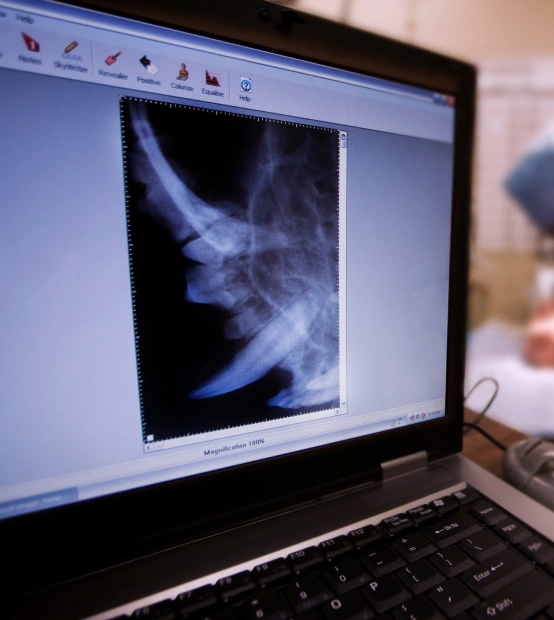
With digital radiology (also known as X-Ray), the medical staff here at TotalBond Veterinary Hospital at Paw Creek has the ability to get a glimpse inside your pet’s body in a safe, non-invasive manner. The high-definition images of your pet’s internal structures allow us to confirm a suspected diagnosis or make a new one. Common x-ray images are of the chest (thorax), belly (abdomen) as well as bones and joints.
The X-Ray machine emits a small, controlled amount of radiation to take the images. The radiation exposure is insignificant for pets of all ages and health statuses. The process itself is quick and can typically be completed at the time of other services. We do our best to accommodate all pets and ensure that they are always as comfortable as possible. Because of this, sedation is often recommended for x-rays as the process can be frightening for some pets.
Cardiac and Abdominal Ultrasound
Ultrasound Imaging Technology works by sending soundwaves through a pet’s body and then relaying the signals to a monitor that shows real-time images of your pet’s internal organs. These images give us greater insight into the structure and function of your pet’s body as well as a better idea of their overall health.
Here at TotalBond Veterinary Hospital at Paw Creek, the ultrasound machine is a staple in the diagnostic process. If your pet is having signs such as vomiting or diarrhea, or if something feels abnormal in your pet’s abdomen, a doctor may recommend using the ultrasound to take a closer look. The ultrasound also serves as an excellent tool for pregnant pets by allowing us to carefully monitor fetal development.
When performing an abdominal ultrasound, the team will need to place your pet on his or her back. Don’t worry, you pet will lay in a comfortable padded trough. For a thoracic ultrasound, pets are often placed on their side. The ultrasound scan itself involves slight pressure with the sensor in order to acquire a good Image. Most pets are very comfortable with this procedure, and it can be performed quickly and efficiently. Mild sedation may be recommended in the event that a more thorough scan Is needed, or if a pet is very anxious about the ultrasound process.
We want our diagnoses to be accurate and based on hard information. Combining ultrasound and digital radiology gives us a comprehensive understanding of your pet’s health or condition. If you have any questions or would like to make an imaging appointment, please feel free to give us a call.


Allergy & Dermatology Testing
In the southeastern United States, environmental allergies are extremely common, especially in dogs. While less common, food allergies can also lead to adverse reactions in the skin. If left untreated, chronic itch can lead to physical and mental distress along with a plethora of skin problems. If your pet is struggling with chronic allergies, our trained clinical team at TotalBond Veterinary Hospital at Paw Creek would be happy to help get the allergies under control.
If you see any of the symptoms below in your pet, we urge you to schedule an appointment with a Paw Creek veterinarian. We want to help your pet.
- Excessive licking, biting, and itching
- Excessive shedding and hair loss
- Inflamed and flaky skin
- Lumps and bumps on the skin
- Behavioral changes from stress and irritation
- Diarrhea
- Vomiting
- Watery eyes
If you have seen any of the aforementioned symptoms in your pet, please schedule an appointment with us as soon as possible. We’ll first perform a physical examination of your pet’s coat, skin, and nails. Then, we will have a discussion with you about changes that you have observed with your pet at home.
After that discussion, we may recommend secondary diagnostic tests for your pet based off of the results of the examination. This may mean skin scrapings, allergy tests, and blood samplings. The majority of these tests can be performed in our in-house laboratory, expediting the delivery of the results to you. Note that although we do basic veterinary dermatology, we are not veterinary dermatology specialists. Advanced cases are referred to a local veterinary dermatologist who we have worked with closely in the past.
After the examinations and tests, next comes treatment plans, which are often multi-faceted. That is, treatment may include topical creams, dietary alterations, oral medications, injections, and more. Our team at will work closely with you to determine the most effective and specialized method for your pet’s wellbeing.

Echocardiogram
Echocardiography is the practice of using advanced ultrasound technology to view the heart in real-time. An echocardiogram is a non-invasive tool that allows our doctors to image the heart and surrounding structures, allowing accurate diagnosing of a range of cardiac diseases. Echocardiograms are often recommended for pets who have had a heart murmur diagnosed on physical exam, or for those who have changes to the size/shape of the heart on chest x-rays.
Heart disease can progress into heart failure, which Is life threatening. Signs of heart disease in pets include fatigue, decreased activity, difficulty breathing, loss of appetite, or abdominal pain. While the echocardiogram is the most effective way to diagnose heart disease, we may recommend additional diagnostics prior to or during the echocardiogram depending on your pet’s specific situation.
For an echocardiogram procedure, we’ll have you drop off your pet about 1 hour before the scheduled time. Since the patient needs to lay on its side and hold still for 15 minutes, we typically give the pet a mild sedative to achieve quality and clear images. The patient is then allowed about an hour of recovery time, and you will be able to pick up your pet at your convenience.
For any further questions regarding the echocardiogram or heart disease, please feel free to give us at TotalBond Veterinary Hospital at Paw Creek a call!
