Same-Day, Urgent Care, Walk-Ins and Drop-Off's Welcome!


Puppy & Kitten Wellness Exams
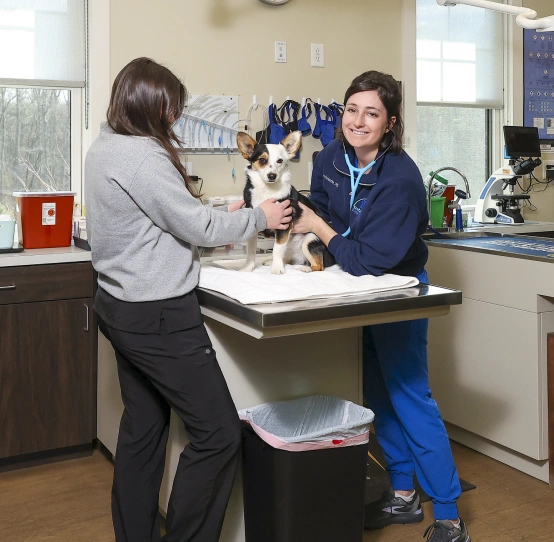
You bring your new baby in for regularly scheduled exams and the same is true for your dog baby. A wellness exam will establish a baseline for your friend, with our doctors reviewing his or her history and doing a nose-to-tail evaluation. We will begin a vaccination and deworming protocol, and lay out a plan for future care, such as microchipping and spay/neuter surgery.
Puppy & Kitten Wellness Care
Are you adding a new puppy or kitten to your family in Mooresville? Let us help you get them started on the right paw! From vaccines to preventative care and everything in between, we’ll chat about your puppy or kitten’s expected lifestyle, and together, we’ll create a health care plan for your pet!
Microchipping
Microchipping, and registering that chip to, your new friend will create a link to you in the event he or she is lost and found. A microchipped animal is more likely to be reunited with his or her family than one who is not. This can be done during an office visit, or when your baby is anesthetized for his or her spay or neuter surgery (because we know you’re already lining that up!).
Spay/Neuter Procedure
One of the best things you can do for your new puppy or kitten is to ensure she is spayed or he is neutered at an age recommended by your veterinarian. And don’t put it off! Why? You’ll nip in the bud some behaviors that work for animals, but aren’t so admired by human family members. You’ll help prevent illnesses and diseases that afflict unsterilized animals. And so importantly, you won’t bring into existence more animals when so many are already in need of forever homes.
Puppy Vaccinations
Thanks to vaccines, once dangerous and potentially deadly diseases are now mostly preventable. Core vaccinations are given based on a recommended schedule over a number of weeks early on and then boosted at intervals throughout his or her life according to the law and your pup’s lifestyle. Optional vaccinations are provided based on age and need based on geographic location. Our will discuss a vaccine schedule with you.
Core vaccinations include:
- Distemper, Hepatitis, Parainfluenza, Parvovirus (DHPP)
- Rabies
- Bordetella
- Leptospirosis
When Should I Spay/Neuter My Pet? Or Should I?
This question is not as straight forward as it used to be. Historically the answer has been Yes, and at 6 months, i.e. before sexual maturity. This helps to prevent accidental pregnancy, the development of certain sex-hormone related behaviors, uterine, ovary, testicular, prostate diseases, and importantly in females, a serious reduction in the incidence of breast tumors and breast cancer.
In the last 5 years, however, some studies are indicating that “Pre-puberty” alteration also leads to increases in urinary incontinence later in life, certain orthopedic problems (hip and knee especially), and an uptick in some other kinds of cancers (lymphoma, hemangiosarcoma, mast cell tumor, osteosarcoma).
Complicating matters is that it is not uniform across the breeds studied (and so far only a few of them have been, and they are all larger breed), nor gender.
In the end, our reading of the literature, drawing upon a consensus of expert opinion, and putting all of these factors together, our typical recommendations are currently:
- Small breed dogs: spay or neuter around 6 months. (not at high risk for joint/tendon problems or the studied cancers).
- Large breed females: here we are a little conflicted, but if you can tolerate going through a heat cycle, on balance we think waiting to spay until 11 – 12 months may be ideal.
- Large breed males: Wait to neuter until 12 – 14 months old UNLESS they showed behavior issues like urine marking/aggression. and then I would neuter ASAP.
(Note: spaying/neutering dogs when they are older and larger is a somewhat more involved surgical procedure than when younger and smaller, so you may find some additional costs associated).
A thorough discussion of the issue and scientific evidence to date can be found on PetMD.

Kitten Wellness Exams
Kittens are babies, and like babies, they need regularly scheduled wellness exams. During your kitten’s first visit, our veterinarians will review any known history and perform a complete nose-to-tail exam to establish a healthy baseline.
Cats are at risk of serious viral diseases that they can inherit from their mother or be exposed to at a very young age, including feline leukemia virus (FeLV) and feline immunodeficiency virus (FIV). Testing kittens for these viruses is essential, as they can significantly impact long-term health and lifespan and may spread to other cats in the household. For this reason, we strongly recommend not introducing your kitten to other cats in your home until test results are completed.
Your kitten will also begin a vaccination and deworming schedule, and we’ll help you plan for future care such as microchipping and spay or neuter surgery.
Core vaccinations for kittens include:
- Feline viral rhinotracheitis
- Calicivirus
- Feline panleukopenia
- Rabies
The feline leukemia vaccine is recommended for all kittens during their first year of life, when they are most likely to be exposed. If your cat remains strictly indoors, ongoing feline leukemia vaccination may no longer be necessary.

Multi-Cat Households
Sharing your home with more than one cat means more cuddles and also comes with unique challenges and responsibilities.
Cats are social beings with a territorial bent. Proper and gradual introduction of each newcomer is essential to safe integration.
Even the best of friends need access to their very own safe and snug space from time to time. Should you find yourself with antagonistic cats or at least one bully, you might have to provide a cooling off place; perhaps using a pheromone product like Feliway.
A multi-cat household means a multi-litterbox household. The rule of thumb is number of litterboxes = number of cats +1. This rule is especially important to follow in homes with male cats.
Food and water should be accessible in neutral spaces. Scratching posts and opportunities for exercise and mental stimulation are important.
As a multi-cat parent, you’ll need to be attentive to each cat’s “normal” so you’re able to identify when someone is not quite right. Sometimes, if you’re not in the room when it happens, you’ll play “process of elimination” to determine who is sick. It will be helpful to have a space where you can segregate animals for that time, as well as when it may be necessary to quarantine someone during an illness or recovery.
Check in with us at TotalBond Veterinary Hospital at Davidson for more tips on multi-cats households!
