Appointments As Early As 8 AM, Monday-Friday!

Advanced Diagnostic Services
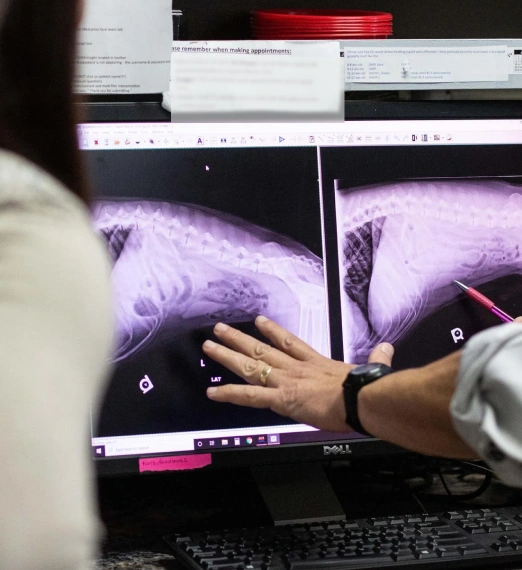
TotalBond Veterinary Hospital at Forestbrook uses state-of-the-art technology to help diagnose and treat a wide variety of pet health conditions. Their in-house laboratory provides fast results, and diagnostic imaging allows veterinarians to learn more about your pet than through a physical exam alone. Clinicians are trained to develop effective treatment plans tailored to each condition.
Laboratory Services
The hospital uses both an outside commercial veterinary laboratory and an in-house lab, so they can offer comprehensive diagnostic care directly to patients. Having lab services on-site allows for quicker turnaround times without sacrificing accuracy.
Common Lab Tests Performed include:
- Complete Blood Count (CBC): Offers insight into red and white blood cells and platelets, helping detect inflammation, infection, anemia, and certain cancers.
- Blood Chemistry Panel: Evaluates organ functions and can show how pets are responding to treatment or dietary changes.
- Urinalysis: Helps diagnose infections or diseases and can often catch issues early when done routinely.
- Fecal Analysis: Assesses for parasites, digestive issues, internal bleeding, and other conditions.
- Cytology & Histopathology:
- Cytology: Microscopic exam of cell samples (e.g., from skin, lumps) for quick, inexpensive insight by our doctors generally while you wait; sometimes sent to a pathologist for overview (2-3 days).
- Histopathology: Tissue samples sent to a pathologist for more detailed diagnosis (typically 3–4 days).
- Microbiology: Cultures fluids (e.g., urine, pus) to identify infections and determine best antibiotics.
- Dermatology Tests: Includes cultures and skin scrapings to check for parasites, bacteria, fungus, and other skin issues.
Common Lab Tests Completed in Our Laboratory
Our lab manages a wide range of diagnostic tasks. Some are routine, like blood work used to get an overall look at your pet’s health. Others will be requested when we want to confirm information on your pet based on outward symptoms or behavior. Here are just a few of the most common lab tests that we conduct at TotalBond Veterinary Hospital at Forestbrook:
Complete Blood Count
Blood is made up mainly of red blood cells, white blood cells, and platelets. Taking a complete blood count (CBC) can tell us a lot about your pet’s health, including information about potential problems like inflammation, infection, anemia, and even some specific types of cancer.
Blood Chemistry Panel
This general test is used to determine how healthy your pet is when it comes to their organ functions. It will sometimes be conducted on a before/after basis to see how your pet responds to treatment or changes to diet or behavior.
Urinalysis
Analyzing urine samples is not only used to help diagnose problems, but can be a great way to prevent future issues from popping up. Regular urine tests as part of your pet’s regular check-up schedule can give our veterinarians a lot of important information, and help us catch infections or diseases when it’s early enough to treat them.
Fecal Analysis
Like urine samples, fecal samples can tell us a lot about your pet’s health, including information about parasites, digestive issues, problems with the pancreas, internal bleeding, and other conditions. For that reason, we recommend that owners bring samples of their pets feces to annual checkups for analysis.
Cytology & Histopathology
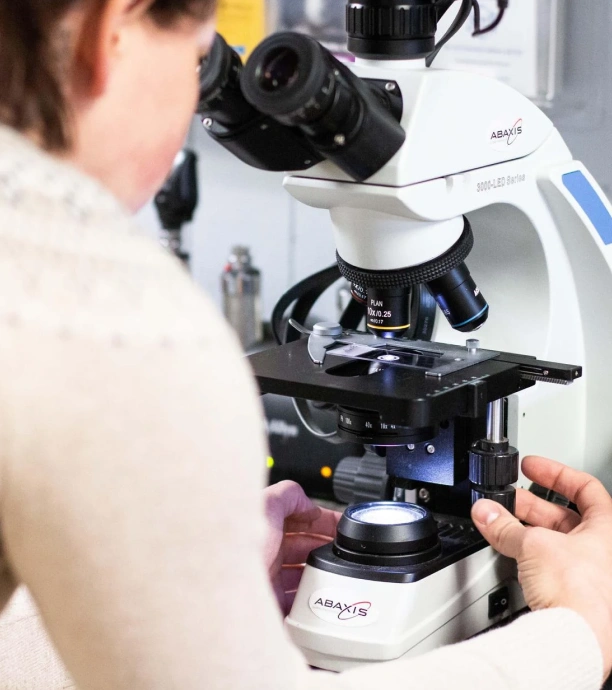
Cytology is the microscopic examination of cell samples taken from skin, lumps, bumps, and other tissues. When we do this in our in-house laboratory, it provides quick, easy, and Inexpensive insight into whatever type of lesion or condition has been observed. In some cases, we will advise that the cell sample be sent to a pathologist for more expert over-read.
Histopathology Is sending an actual tissue sample to the lab for a pathologist to read and diagnose. This is always done through our commercial laboratory and generally takes 3-4 days for a result.
Microbiology
We will often send a sample of fluid – urine, pus, or other material – to be cultured that we may a) Identify the organism causing an infection, and b) Identify the best antibiotics that will work against it (and conversely, which ones to avoid).
Dermatology
Cultures, skin scrapings, and other microscopic analyses are often used to look for parasites, bacteria, fungus, or other abnormalities that your pet may have picked up. These are commonly performed with pets exhibiting itchy or other abnormal skin, coat, or ear problems.
Allergy & Dermatology Testing
Pets’ skin, ears, eyes, and feet are checked for signs of allergy or irritation. Signs that may prompt testing include excessive itching, scratching, changes in behavior, or watery eyes. For severe cases or if more advanced dermatological expertise is needed, the hospital can refer to veterinary specialists in Charlotte.
Specialized Monitoring Tools
The hospital is equipped with advanced monitoring technology, including:
- ECG (Electrocardiogram): Records heart electrical activity and conduction.
- Blood Pressure Monitoring: Checks for hypertension or hypotension.
- Capnography: Measures carbon dioxide output.
- Pulse Oximetry: Measures blood oxygen saturation.
- Continuous Blood Glucose monitors: for regulation of diabetes
These tools are valuable for emergencies, anesthetic monitoring, and chronic care.
