Extended Weekday Hours & Saturday Appointments Available!


Complete Diagnostic Care for Your Pet
Yearly physical exams, as well as vaccinations, parasite control and testing, microchipping, and nutrition and weight counseling are all part of TotalBond’s preventative services.
Laboratory Services
We take pride in the fact that, rather than send your pet’s samples to another laboratory, we can perform important tests right here in our own facility. We expedite the diagnostic process because the TotalBond Way means that relationships make the difference. Especially in cases where time is of the essence, our goal is to get you the information you need as soon as we can, from the data we collect, to the conclusions we draw.
Since our laboratory is located within our hospital at TotalBond Veterinary Hospital at Bethel, we can ensure you that not only are we providing the best attention to detail, but also quick turnaround time on results. We understand waiting for results can be stressful, that’s why we make every effort to deliver those results as quickly as we can without sacrificing our quality service.
Lab Tests Completed in Our Laboratory
We manage a variety of diagnostic tests here at TotalBond Veterinary Hospital at Bethel, including blood work which helps us get a glimpse into your pet’s overall health. We might request other kinds of lab tests to confirm a diagnosis based on your pet’s symptoms or behavior. Below are a few common lab tests we conduct right here at TotalBond Veterinary Hospital at Bethel
Blood Chemistry Panel
This general panel tests for how healthy your pet’s organs function. In some cases, this test will be conducted on a before/after basis to identify how pets respond to treatment options or changes to behavior or diet.
Urinalysis
Scheduling regular urine tests can give your veterinarian a lot of helpful information to not only diagnose problems, but prevent future health issues in your pet. Urine tests will also help catch diseases or infections that are early enough to treat.
Fecal Exams
Similar to urine tests, fecal exams can give veterinarians a lot of helpful information into your pet’s health, including parasites, problems with pancreas, digestive issues, internal bleeding, and more. We recommend pet parents bring in fecal samples to annual exams for analysis.
Complete Blood Count
Blood is composed to white blood cells, red blood cells, and platelets. A complete blood count (CBC) can help us identify any issues in your pet, including inflammation, anemia, infection, and cancer.
Cytology
Skin cytology and fine needle aspirates are quick, minimally invasive diagnostic tests that help our veterinarians evaluate lumps, bumps, and skin conditions in pets. For a skin cytology, we collect a small sample of cells from the surface of the skin or a lesion using tape, a swab, or a gentle scrape, then examine the cells under a microscope to check for bacteria, yeast, parasites, or inflammation.
A fine needle aspirate (FNA) involves using a very small needle to collect cells from a lump or mass just under the skin. The sample is then evaluated under a microscope to help determine the type of cells present and whether the mass is likely benign, inflammatory, or something that requires further testing.
Both tests are typically quick, well-tolerated by pets, and can often provide valuable answers the same day, helping us recommend the most appropriate treatment plan for your pet.
Digital Radiography
Radiographs, commonly known as X-rays, are an important diagnostic tool that allow our veterinarians to view your pet’s bones, lungs, and heart. This non-invasive imaging helps us diagnose conditions such as arthritis, fractures, and pneumonia.
Taking X-rays is typically quick and painless. Your pet is briefly exposed to a small amount of radiation to capture images of structures inside the body. Most pets can remain awake for the procedure, though mild sedation may be recommended if needed for comfort or positioning.
After the images are taken, they are sent to a radiologist for review. Results are usually available within a few hours, and we will contact you once we receive the report.

Allergy & Dermatology Testing
Just like people, pets can have allergies and skin issues too. We understand these issues in pets can cause stress, both mentally and physically. Generally, we refer to any condition causing skin inflammation, dermatitis. Dermatitis can be caused by several factors, including external irritants, infection, allergens, and internal disease. It’s also important to note that some pets might have a genetic predisposition to certain types of allergies and skin sensitivities.
It’s important to pay attention to your pet’s behavior if you suspect allergies or a skin condition. If these irritants are left untreated, what started as an itch can escalate to physical pain and mental stress. Our team at TotalBond Veterinary Hospital at Bethel can help your pet reclaim their mental and physical wellbeing.
As you may know, allergens can be found everywhere: in the food we consume, the air we breathe, and even the environment we live in. Some of the most common allergens include weeds, grasses, flowers, grains and wheat, perfumes, protein sources, and cleaners.
If your pet is showing any of the following signs, we highly encourage you to make an appointment with one of our doctors to help give your pet the relief they need:
- Excessive itching, licking, or biting the skin
- Inflammation of the skin (flaky skin)
- Excessive hair loss or shedding
- Vomiting/diarrhea
- Watery eyes
- Lumps or bumps on skin
- Behavioral changes
During a dermatology appointment, we’ll perform a physical exam to assess the skin, nails and coat’s condition. Also, be prepared to answer questions about any symptoms you’ve observed, sudden changes at home, and more. We will then recommend any diagnostic tests we think would be beneficial for your pet, which may include blood samples, allergy tests, or skin scrapings. Each of these tests will be processed in our diagnostic laboratory, which will allow us to return results to you faster.
It’s important to note that pets are oftentimes allergic to multiple variants, and treatment plans can be multi-faceted. Some treatment options include topical creams, oral medications, injections, dietary changes, and more. Our team at TotalBond Veterinary Hospital at Bethel will work with you to provide your pet with the most effective treatment option.
At TotalBond Veterinary Hospital at Bethel, we are happy to consult with you on your pet’s allergy and dermatology needs. We practice basic veterinary dermatology, however, we are no veterinary dermatology specialists. Advanced cases will be referred to a local veterinary dermatologist.

Echocardiogram
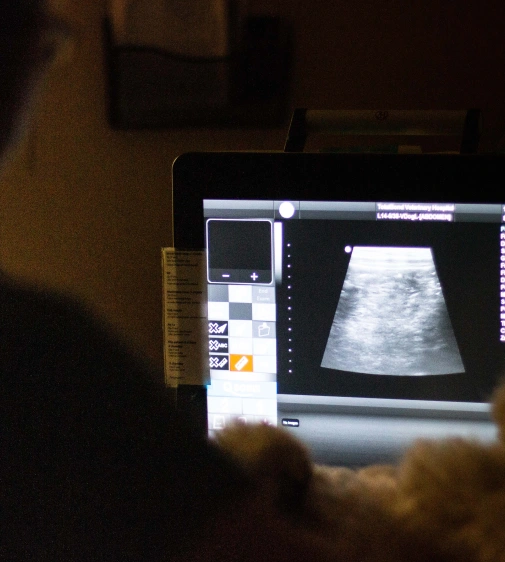
An echocardiogram uses ultrasound waves to create an image of the heart in real time. At TotalBond Veterinary Hospital at Bethel, we use echocardiograms to diagnose heart disease in pet patients. They’re very effective because they let us get a real-time look at the heart so that we can watch it pump, work its valves and more. We can see whether the heart is functioning the way it should, and if not, what might be causing the dysfunction.
We often use echocardiograms alongside x-rays and bloodwork to get a complete picture of what’s going on with your pet’s heart so we can give the most informed diagnosis and path forward possible.
Most pets don’t need to be sedated or given general anesthesia for an echocardiogram. They simply lie down on a table, are given lots of love and affection from our team, and are gently restrained for about 20 minutes while the echocardiogram is taken. If your pet is severely anxious and won’t sit still for that period, we’ll talk to you before we take any other steps like sedation.
Pets also generally don’t need to be shaved for an echocardiogram. Dogs with extremely thick, heavy coats will sometimes need to have small hair patches shaved so that we can get a clear image of the heart. We’ll never shave any part of your pet’s fur without consulting with you first and receiving your approval.
Overall, echocardiography is a painless, non-invasive, and relatively quick way to have an in-depth look at your pet’s heart. It requires no special preparation from your pet in terms of dietary or exercise restrictions. There’s also no delay between the echocardiogram being taken and getting results— your TotalBond Veterinary Hospital at Bethel veterinarian will be able to meet with you immediately afterward and discuss what they’ve found, diagnosis, and next steps.
